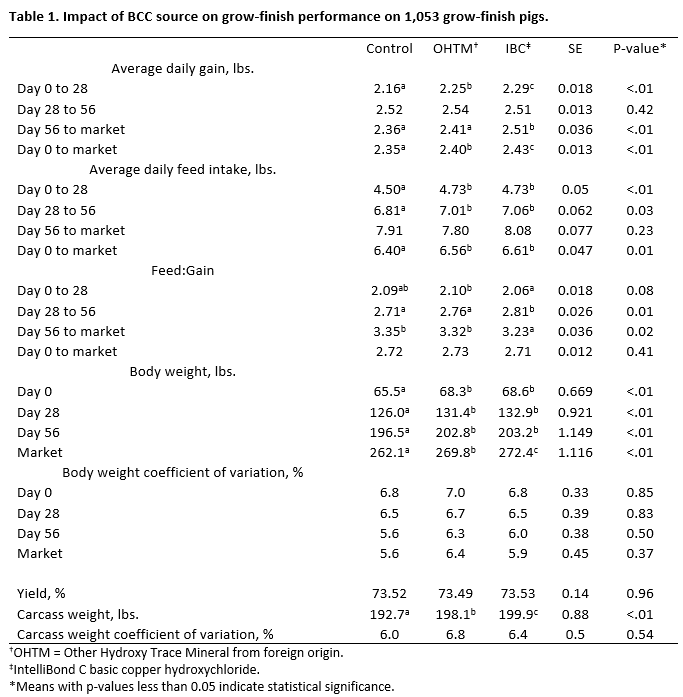
Results suggest basic Cu chloride enhances finishing throughput.
Micronutrients, such as copper (Cu), account for a very small portion of pig diets. Yet Cu source can have a sizable impact on grow-finish performance. Differences exist between differing forms of Cu such as Cu sulfate, basic Cu chloride (BCC) and organic sources of Cu. Yet within Cu form, few studies have looked to establish differences. Therefore, the objective of the current study was to evaluate differences in grow-finish performance between two sources of BCC, IntelliBond C and another hydroxy chloride mineral (OHTM) BCC in the presence of a Cu sulfate control diet.
Pigs from second parity sows at the North Carolina Department of Agriculture Tidewater Research Station (Plymouth, NC) were used. Sows were Landrace x Large White composites mated to Smithfield Premium Genetics’ Duroc boars. Hence, pigs were 50% Duroc and 50% whiteline. At weaning, piglets were vaccinated for PCV2 and Ileitis and placed in a nursery. At completion of the nursery phase, gilts and barrows (n=1,053) were randomly allocated within sex to one of 117 finishing pens (9 pigs per pen, 7.45 ft2 per pig). Treatments included a control (15 ppm), IntelliBond C (fed at 150 ppm Cu) and an OHTM Cu (fed at 150 ppm Cu). Treatments were fed from weaning to market and finisher entry to market in replicates 1 and 2, respectively. Housing consisted of fully slatted floors and natural ventilation. Animals were transported to a harvest facility and carcass weights collected. Data was analyzed in SAS using PROC GLM. Traits included pig weight, average daily gain, average daily feed intake, feed efficiency, variation in body weight, carcass weight and yield. Replicate, barn location, sex and diet were included in statistical models. Pen was the experimental unit. Results from the study are shown in Table 1.